
From Financial Stewardship to Strategic Leadership: A CFO’s Perspective on Finance, Ethics and the Future of Business
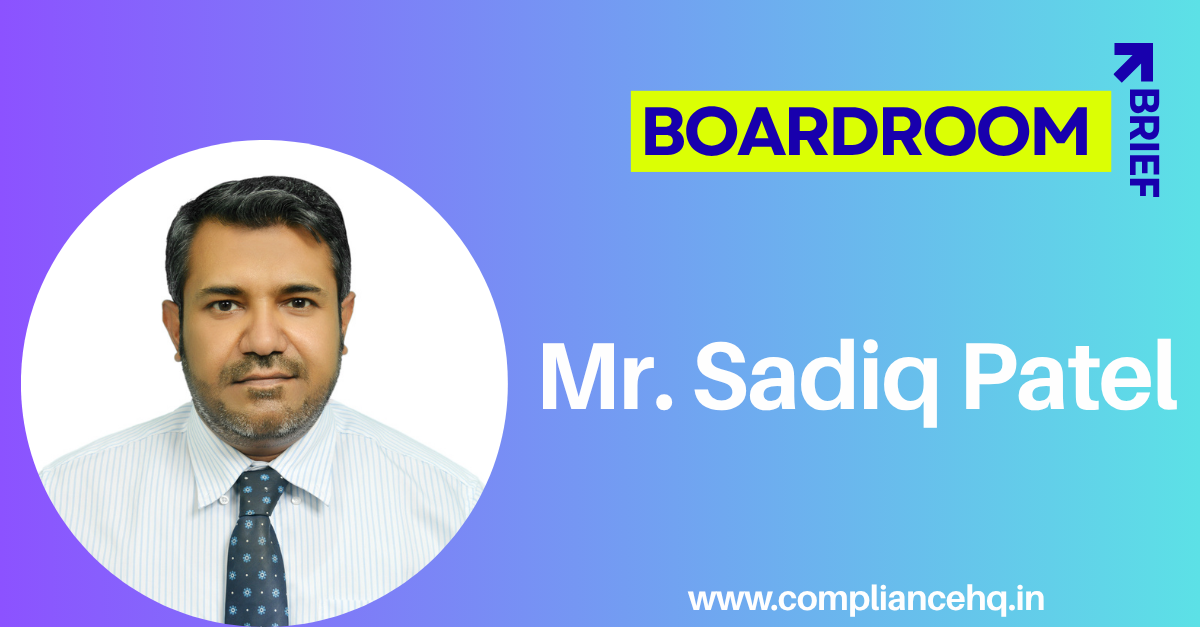
Boardroom Brief by ComplianceHQ
The role of the Chief Financial Officer has evolved significantly. No longer confined to financial reporting, cost control and compliance, today's CFO is increasingly expected to contribute to strategy, profitability, operations, risk management and long-term business growth.
In this edition of Boardroom Brief by ComplianceHQ, we speak with Mr. Sadiq Patel, CFO of Australia Laboratory Services Arabia Co. Ltd., a Chartered Accountant from India with 28 years of professional experience and a career spanning diverse sectors and leadership roles in Saudi Arabia.
Mr. Patel has witnessed first-hand the transformation of the finance function and the changing business environment in the Kingdom. His experience includes overseeing financial reporting across multiple operating companies, managing finance during periods of significant business distress, implementing financial and operational best practices, and navigating an increasingly regulated and globally integrated financial landscape.
In this conversation, Mr. Patel reflects on the experiences that shaped his leadership philosophy, the evolving role of the CFO, the balance between growth and financial discipline, the importance of ethics and governance, and the impact of AI and digital transformation on the future of finance.
Your Journey
Could you introduce yourself and tell us about your current role, professional focus, and the journey that led you to build your career as a Chartered Accountant and senior finance leader?
I am a qualified Chartered Accountant from India. I have served diverse companies operating in different sectors in Saudi Arabia in various leadership roles. The professional focus has always been to provide ethical management of company finances, reporting transparency, using latest technology and implementing high standards of propriety and due diligence when making financial decisions. Currently I am serving Australia Laboratory Services Arabia Co Ltd as CFO.
Looking back at your career, which experiences, professional transitions, or turning points have had the greatest influence on your approach to finance and leadership?
Working at AlHamrani Group of Companies overseeing financial reporting of nine operating companies gave me very broad understanding of diverse business. I learnt many things on financial management and later these skills helped me in operating roles. Seeing how the Group CFO and Finance Directors operate set high benchmarks on my own performance and operating style.
You have worked in senior finance roles within a dynamic business environment, including your experience in Saudi Arabia. Which professional achievements, transformations, or challenges are you most proud of, and why have they been meaningful to you?
I am very proud of all achievements made over the years. But I would like to particularly highlight my experience in managing the finance of Saudi Paint Co Ltd. Here was a 40-year-old company struggling for survival in the fast-changing world and having financial difficulties, suffering from mismanagement in the past. It was an opportunity to streamline its finances and operations, implementing all the best practices. I am proud to navigate the company through times of extreme distress and turbulence, both internal and external.
Leadership & Strategic Finance
How would you describe your leadership philosophy as a CFO? What principles guide the way you make financial and business decisions?
I always follow a participative style, calling inputs from various stakeholders. I do believe that the support of stakeholders is important in achieving set objectives. While guiding CEO and Board in making financial decisions, I always follow the propriety principle and implement high ethical standards and transparency.
In today's environment, the CFO is increasingly expected to be a strategic business partner rather than only the custodian of financial reporting. How do you see the CFO's role evolving?
There is a great transition in the CFO role, from bookkeeping to a profit maker. Today, CFOs are expected to lead the company to profitability, earlier the focus was on costs and controls. So, the CFO now is expected to identify new profit opportunities. He is expected to have the skill set of setting strategy and managing operations, in addition to the traditional roles of being a fund raiser.
How do you balance financial discipline and cost management with the need to support innovation, growth, investment, and long-term business opportunities?
Growth is the need of all organizations, as life itself is about growth. To grow the business, certain risks have to be taken. The key is to ensure the risks are rational, balanced and can be sustained in case of failure. So, to grow the business, the managers need to take investment risk, credit risk and operational risks. We in finance need to define the controls, limits and enforce them.
What do you believe organisations and leadership teams often overlook when making decisions around profitability, cash flow, risk, and sustainable growth?
I do believe that managers are driving to achieve sales and profit targets, which in many instances leads them to make short-term and irrational decisions. Another risk managers often take is by expanding to new territories and areas, hoping to repeat the current success and business model in these new set-ups, totally ignoring local dynamics.
Ethics, Governance & Responsible Finance
Finance leaders often have to make difficult decisions where commercial interests, risk, compliance, and ethical considerations intersect. How do you approach such situations?
Before making any decisions, the factual data has to be verified for accuracy and completeness. I also engage with the stakeholders for their perspectives. Any decision without the opinions of the parties involved and the stakeholders will be incomplete.
What does strong financial governance mean to you, and how can CFOs help build a culture of transparency, accountability, and ethical decision-making across an organisation?
Strong financial governance can be achieved by keeping the interest of the company first. This essentially means that the cannons of propriety and transparency is observed. We help implement ethics by instituting a system of effective internal controls, monitoring and ensuring compliance.
In your view, how can finance leaders ensure that short-term performance pressures do not compromise long-term stakeholder value and organisational integrity?
This is an area of conflict with the decision makers. We should make transparent financial reporting and support our perspectives with factual data. This may involve changes in strategy and some painful decisions affecting some stakeholders. But as custodians of company resources, we need to play the devil’s advocate.
Business Transformation & The Future of Finance
AI, automation, advanced analytics, digital transformation, and evolving regulatory expectations are reshaping the finance function. Which changes do you believe will have the greatest impact on CFOs and finance teams over the next five years?
AI will change the way we do business and will have deep effect the way accounting operations are conducted. Computer systems and ERP software brought big changes in the business and now AI is taking it to the next level. I believe a lot of finance jobs will be automated, affecting some jobs. But the role of finance as a contributor to decision making will remain intact.
Having worked in the Saudi Arabian business environment, what opportunities and challenges do you see for finance leaders as the Kingdom continues to diversify its economy and pursue large-scale transformation?
Saudi Arabia was a tax-free economy, with little regulation. Now the environment has changed with implementation of full spectrum of tax legislation and more are expected. Also the Kingdom is integrating with the world by implementing international standards in financial reporting, as the stock market evolves and the Kingdom targets more investment from foreigners in the economy. As the kingdom pursues great financial integration with the world at large, I see the role of finance evolving.
What capabilities will the next generation of CFOs and finance professionals need to develop to remain effective strategic leaders rather than simply technical finance specialists?
As I said CFO’s are now looked upon to generate profits and identify investment avenues. Going forward, CFO’s need to have skill set as strategy officer and operating officer.
If you could leave today's CFOs, finance professionals, and business leaders with one principle or piece of advice based on your career experience, what would it be?
CFO’s are the custodians of the finances of their organisation. We need to fulfil this obligation to the best of our ability by implementing robust standards of financial governance.
Profile
Sadiq Patel
- Current Designation: CFO, Australia Laboratory Services Arabia Co. Ltd.
- Educational and Professional Qualifications: B Com, Chartered Accountant
- Total Professional Experience: 28 years
- Previous Key Role: Saudi Paint Co. Ltd, Head of Finance
- Professional Association: Institute of Chartered Accountants of India
Areas of Expertise: Financial accounting, Reporting, Budgeting, Strategy, Costing, IFRS, Zakat & Tax, Treasury, Project finance, Risk management, Systems implementation, Internal Auditing and Team management.
Run this in your own boardroom
ComplianceHQ turns regulatory change into owned actions, evidence and board-ready reporting.
The 20 latest briefings, once a week.